The 4 Signs Your Body Is Stuck in Valsalva (Even When You're Not Playing)
Most brass and wind players who are dealing with the Valsalva maneuver are looking for the answer on the instrument.
They're analyzing their attacks, monitoring their breath, or trying to catch the moment it happens so they can stop it in real time and shift their focus.
And this approach does make sense. That's where these symptoms show up!
But here's the part that changes everything once you understand it: the Valsalva maneuver doesn't start when you pick up your horn.
For many players, the body is already bracing before the first note is ever played.
That means if you want to find a long-term solution, you have to look somewhere else first.
If you haven't checked out the first blog article of this series, take a moment and read through the preceding so you can have context on the concepts presented below: Why Brass Players Can't Relax: The Hidden Cause of Valsalva Maneuver.
Sign 1: Your abs feel "on" even when you're sitting still
This is a common feeling. This isn't soreness or fatigue (though you could feel that too), but rather a steady engagement that occurs during inhalation and exhalation. A steady engagement.
This is like a low-level grip happening in your trunk that you can't quite turn off, even when you're at your desk, in your car, or lying on the couch watching TV.
This is one of the most commonly reported experiences in brass and wind players dealing with Valsalva, and is often one of the most overlooked.
In a recent survey I conducted across social media, nearly half of the respondents reported feeling like their abs were always "on" or gripping, even when not playing at all.
These clues indicate that this is not a playing habit, but a resting state of the system.
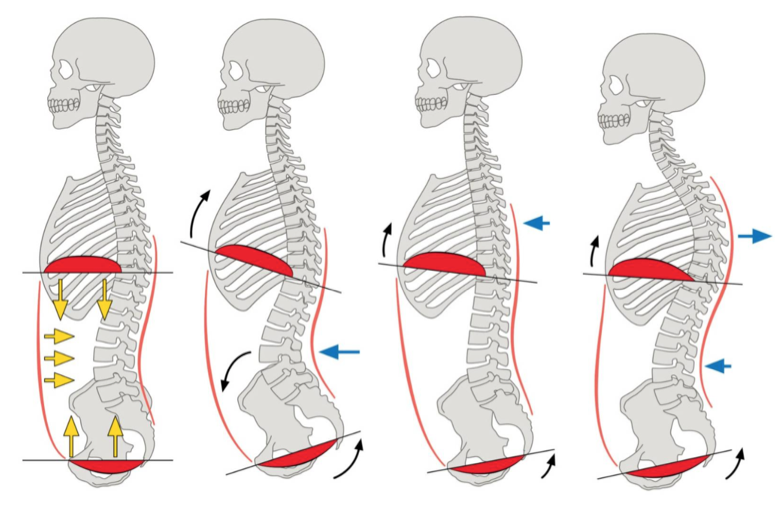
When the trunk is chronically braced, it doesn't wait for a musical demand to activate. In fact, it's already activated. So when you go to play, internal pressure is increased at a baseline level, muscle tension is increased, and your "window" you have to navigate relaxed playing shrinks depending on how much pressure and tension is present.
So when you ask a system to manage airflow freely on top of one that is already pressurized, it can start to find compensatory ways to manage that pressure. If it can't - the system will start to "break down."
To summarize, it's like trying to pour water through a hose that's already been kinked.
Sign 2: You notice you hold your breath in everyday situations
This is another common symptom: noticing that you hold your breath in everyday situations.
This could be before you send a difficult email or when you stand up from a chair.
Or even before you walk into a room where you'll be evaluated or observed.
This one is easy to miss because it happens fast and unconsciously, and in many cases, it's a natural response to everyday movement and life.
But if you pay attention, you may notice that your breath and glottis close briefly in moments of low-level stress or anticipation throughout the day. Again, this is natural, but the key is to observe whether you are holding on to the grip more than you need to. Do you relax those areas after standing up? Or is the brace still present?
Depending on your instrument and how you respond to performance anxiety, this sensation may show up before a high-stakes entrance. The same bracing. The same pressurization.
The Valsalva maneuver at the instrument is often just the most noticeable version of a pattern the body is using to support you through day-to-day life. The more you notice it in everyday life, the more clearly you can see that this isn't a playing problem, but rather a whole-system pattern that playing simply amplifies.
Sign 3: Your jaw or neck feels locked in the morning (or during the day), before you've even practiced
This one surprises people, and in the survey, it surprised me!
If the Valsalva maneuver is a playing problem, why would your jaw be tight before you've touched your instrument?
As we covered in the previous article, the jaw is the top of the pressure chain.
When the system below it (the pelvis, trunk, and ribcage) becomes disorganized and starts compensating, the neck and jaw are often where that tension expresses itself last within your body
In the same survey, nearly 60% of respondents reported TMJ issues alongside their playing symptoms. Most attributed it to playing, but from a biomechanical perspective, the timeline doesn't always add up.
For example, many reported that the jaw tension was present throughout the day, at meals, first thing in the morning, or during conversations, not just after a long practice session.
When your neck and jaw are overworking to provide stability to the body, or are bracing due to various amounts of stress, this is a sign of a system that is under duress. Aka - a system that has increased internal pressure, increased base levels of tension, and a lower capacity to recover from day-to-day activities.
The instrument may have been a factor, but again, this is a full-body strategy your body is using to move through space and "survive." Playing may have caused tension, but the body is still keeping score.
Sign 4: You can't fully relax, even when you consciously try
This is perhaps the most telling sign of all, and I lived this for many years.
You know you should relax.
You've been told to relax.
You've tried to relax.
And yet there's a persistent sense of internal pressure, tightness, or readiness that doesn't fully release, even when you're at home, removed from any performance context, trying your best to unwind.
Or maybe you are able to relax, but under high stress, you feel your symptoms come back and your playing seems to unravel before your eyes.
In the survey, nearly half of the respondents reported difficulty relaxing even at rest.
Let that land for a moment.
This isn't the same as relaxing before a performance or during a difficult passage.
This is difficulty relaxing at rest.
Again, this is not due to a Valsalva maneuver issue with the instrument. This is indicative of a nervous system that is constantly under stress and in a state of activation.
If you want to learn more about the nervous system, I go into more detail in another article: Deconstructing the Diaphragmatic Breath
When the body has been in a chronic bracing pattern long enough, it loses the felt sense of what neutral, or "stacking the ribcage," is. The system doesn't know it's compensating; it's simply trying to find the most "effective" way to manage the stress of gravity, movement, and surviving. This is actually a very normal and fundamentally sound evolutionary response. But for our playing? Not so much.
And this is exactly why the standard advice, just relax, breathe more, let go, doesn't work for players who have been dealing with this for years.
The instruction is technically correct - this is the ultimate goal, but the body isn't capable of following it yet because it doesn't have access to this shape anymore.
What this tells us
If you recognized yourself in three or four of these signs, the most important thing to understand is this: your body is not broken, and you are not making this up.
What you're describing is a system that has been under stress for a while and has a higher baseline of tension throughout the body.
Let me also say this pattern isn't in your head, nor is it a mental block (although we can absolutely trick ourselves into thinking it is).
So how do we fix this?
More Valsalva exercises before we play? Change the way we play?
Perhaps, but that is not the first step.
The resting state has to change first.
The system has to stop bracing before it can start freely managing the pressure demands of playing. And at a fundamental level, the system needs to be able to manage pressure through day-to-day life.
As humans, we need to be able to create pressure and release pressure. Absorb force, create force, let the force travel through our bodies. This is movement. This is propulsion. All living beings (and non) abide by this universal principle.
And this is exactly what the Breathing Foundations: The Valsalva Method program was built to address. We start with rebuilding your foundation from the ground up, before the instrument is ever in your hands.
The program launches at the beginning of June, and if you've been dealing with hesitations, locked air, or the feeling that your body is working against you, no matter what you try, this is the program that starts where the problem actually starts.
This isn't a silver bullet, but rather a movement-based system that will help you start to reduce tension, reteach your body how to pressurize, and learn a system you can make your own. Everyone is different, but the principles remain the same.
Join the waitlist below to be the first to know when registration opens. And before you ask - no, we do not spam your email!