
Why Brass Players Can't Just Relax: The Hidden Cause of the Valsalva Maneuver
Why Brass Players Can't Just Relax: The Real Cause of the Valsalva Maneuver
If you've ever frozen before a first note, felt your air get trapped mid-phrase, or noticed your attacks becoming explosive and unpredictable, you've likely encountered the Valsalva maneuver.
And if you've been told to just relax, breathe more, or stop overthinking it, that may work for some, but if you are like many of the musicians I've worked with over the years, you already know that advice wasn't a long-term solution for you.
Here's why.
What the Valsalva maneuver actually is
The Valsalva maneuver is your body's natural bracing reflex.
This is the same thing that happens when you hold your breath to lift something heavy, brace for impact, or strain under physical load. Your diaphragm locks, your glottis tightens and closes, and your entire trunk pressurizes like a sealed container to generate more pressure (aka - force).
Within these contexts, it's useful! This naturally protects your spine during heavy movements, stabilizes your core, and helps you manage extreme physical demands.
But when it shows up while you're trying to play a legato phrase at piano dynamic?
This is a problem.
Why does it show up in brass and wind playing?
For most players, the Valsalva maneuver doesn't arrive all at once. It can show up as a one-off single event, or can build gradually so that by the time you notice it, it's already deeply embedded in how you play.
For the latter, it can be helpful to think of Valsalva as following the same pattern as overuse injuries, in that it builds over time. You may not always remember the moment it started, but you just know that at some point, something stopped working.
When it builds over time in this context, it tends to start small, usually with a slight hesitation before a tricky entrance, a moment of over-preparation before a high note, and quietly compounds from there.
Here are a few events worth observing:
Perfectionism and performance pressure.
When a note feels high-stakes, the nervous system responds. You brace before the attack without realizing it. The note speaks — or doesn't — and over time, the pattern can get reinforced.
Mistimed breathing.
If you're not getting air in efficiently, the body compensates by pressurizing what it has and recruiting accessory breathing musculature. This can include the back, chest, shoulders, or most commonly, the neck. Over time, that compensation becomes the default.
In addition, if your breathing cadence is off, you can finish inhaling before your attack and have to hold to play in time with everyone else, or not give yourself enough time and recruit tension to draw in enough air in the short amount of time allotted.
Trying too hard.
What is the usual response when we miss a note or a note doesn't speak?
More air, more support, and more effort.
These are all reasonable instincts and can trigger the same bracing response. Again, not a bad response, just a natural one.
In the early stages, these could be largely mental or technical issues. In this case, address the habit, clean up your breathing, and observe your physical tendencies through self-observation; these problems usually resolve themselves.
But usually, when someone has been struggling with valsalva, they have been working through this issue for a long time.
For these players, the ones who have attempted to address the habit, coordinate their breath, and develop a high level of technique, if the problem still persists, something else is going on.
In this case, the pattern has moved into the body itself. And that changes everything about how it needs to be addressed.
The resting pressure system: why it starts before you play
Here's the part that most players and teachers haven't considered.
Your body is always managing pressure.
Every breath, every step, every moment you're sitting or standing, your ribcage, diaphragm, pelvis, and feet are in a constant pressure negotiation.
When that system is well-organized, pressure flows and redistributes freely through the feet, knees, hips, ribcage, and skull.
When the body loses the ability to organize efficiently or to change shape (e.g., getting stuck in the same position; see examples below), it will compensate accordingly. This can be seen in postural adjustments, compensatory movements, and increased overall resting muscle tension in the pelvis and ribcage, as seen below. Notice that the ribcage and pelvis lost a relatively parallel stacked relationship.
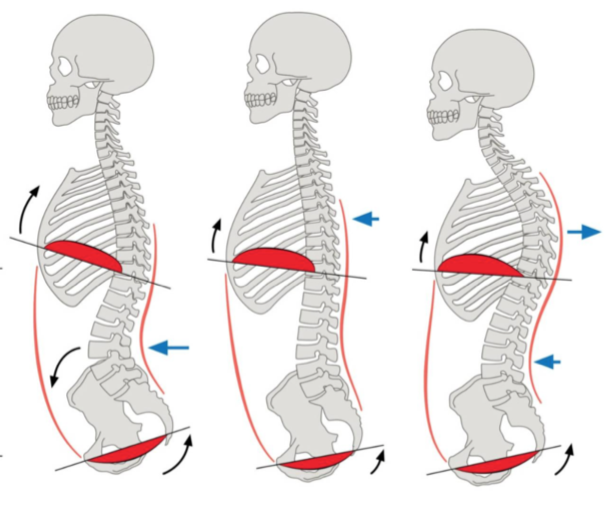
These shapes are compensatory, and are often described as "posture." For the sake of this article, posture isn't something to chase, it's simply a reflection/snapshot of the underlying systems of the body (pelvis, ribcage, breathing strategy, overall stress, movement capacity, etc.).
In short, how your ribcage and pelvis sit at rest, either flared and over-expanded, or compressed and gripping, will directly correlate to how much internal pressure your body will have at rest, before any musical demand is placed on it.
So when you pick up a brass or wind instrument, which can demand precise, high-pressure airflow management, your already-compensating high-pressure system gets one more load.
The body's response?
Bear down harder. Recruit more muscle activity. Close the throat. And Grip the abs.
Why "just relax" and breathing cues don't fix it
Based on the previous section, this is why the standard advice often fails, or can take years to make what seems like little progress.
Telling someone to relax when their nervous system is chronically activated, or bracing, is like telling someone with a sprained ankle to just walk it off.
The instruction is technically correct, but the body simply isn't capable of following it yet.
The same goes for breathing cues. "Breathe from your belly." "Expand your back." "Take a bigger breath." Reteach yourself how to play. These are all reasonable ideas, but if your house is built on a sand foundation, rebuilding it on the same foundation is only a temporary fix.
These are impeded responses layered on top of a structural pattern that doesn't change because you thought about it differently.
You cannot out-cue compensation.
If the ribcage can't expand in all directions at once, lacks the mobility to do so, or feels tight/stiff/tense at rest, telling it to expand won't make it expand. If it does, it's thanks to your accessory breathing musculature. Again, not ideal, as this just increases the pressure on an already pressurized system.
This is also why the issue often gets worse when players become hyper-aware of this issue. Awareness increases focus, focus increases tension, tension feeds the bracing response. It becomes a loop that can easily become cyclical. Several players have described it exactly this way — figuring out what was happening made it harder to stop, not easier.
So what can we do about it? Where do we start?
What actually addresses it
If the Valsalva maneuver is rooted in the resting state of the pressure system, the solution has to start there, too.
That means working on the body before the instrument is ever in your hands.
In a recent survey I performed across social media of brass and wind players (I know, social media - take it with a grain of salt. Still helpful!), over 70% reported dealing with these symptoms for two years or more, and the majority described their impact as moderately to significantly limiting. That timeline matters. It tells us this isn't something that resolves on its own, and it isn't something technique alone can fix.
So let's focus on the process for reverse-engineering this problem.
Decreasing resting muscle tension.
Before anything else, the system needs to stop being in a constant state of bracing. In the recent survey, over half of respondents reported chronic stiffness or feeling "locked" in their posture, and nearly as many reported difficulty relaxing even at rest — outside of playing entirely.
This tells me this is not a playing problem. This is a sign that the nervous system is running hot all day. To improve the system, the process starts with releasing the accessory breathing muscles, reducing overall tension, and restoring the body's ability to decompress. In my dissertation, this is also supported by multiple studies and is an essential skill for overall recovery and longevity of health. In the context of Valsavla, it's also the necessary first step before any structural work can take hold.
Restoring ribcage mobility.
A ribcage that's stuck, either flared or a sternum that is compressed (aka rounded shoulders or forward neck) can't respond to active breathing demands.
Over 60% of respondents reported a constant sense of internal pressure or bracing, and nearly half described feeling like their abs were always "on" or gripping.
Positional breathing drills, decompression work, and targeted release of the muscles around the ribcage give the system room to actually move again.
Reorganizing pelvic and postural orientation.
The pelvis and ribcage work together to manage pressure from the ground up. When that relationship is off, the trunk braces to compensate. Neck, upper trap, and lower back tightness were reported by more than half of survey respondents and are often downstream symptoms of a high-pressure system. Restoring pelvic orientation gives the diaphragm the environment it needs to function freely, rather than fighting against a compressed or disorganized base.
Reestablishing ground contact.
How you connect to the floor, through your feet, determines how pressure travels through the whole system. This sounds distant from a brass playing problem. But when the foundation is unstable, the body recruits tension from wherever it can find it, and for wind players, that often means the trunk, then the ribcage, then the neck, and last - the jaw.
Nearly 60% of respondents reported TMJ issues alongside their playing symptoms. That's not a coincidence. It's the same bracing pattern expressing itself at the top of the chain, a sign that other areas need to be addressed, but in this context, we need to release the jaw first before we can address ribcage shape and movement.
Only once the resting system is reorganized does it make sense to bridge that work back to the instrument. That's when breathing cues actually stick. That's when attacks, which over 75% of respondents described as their primary playing symptom, stop being a source of dread. That's when the body and the music stop fighting each other, and freedom of pressure management can occur.
Ready to address what's actually causing it?
If you've been dealing with hesitations, locked air, or the feeling that your body is working against you, and you're done being told to just relax, the Breathing Foundations: The Valsalva Method program was built for exactly this.
The program will launch at the beginning of June, and more info will be shared in May. Join the waitlist to stay posted on updates and access a special early-bird discount.
