Traditional Breathing Exercies - Why They Might be Holding You Back From Overcoming the Valsalva Manuever
If you've been dealing with the Valsalva Maneuver for any length of time, there's a good chance you've already tried the standard fixes.
Within traditional pedagogy, breathing exercises can include any number of techniques or cues.
Examples of specific techniques include belly breathing,
diaphragmatic breathing, or yogic breathing, to name a few.
Breathing cues might sound like: support from the belly, support from the diaphragm (yuck), expand your back as you inhale, inhale fast, inhale slow, breathe low or breathe high, take a bigger breath, and the list goes on.
If you're reading this, you've probably experienced any number of these in real time.
Maybe some worked in the moment, only to fall apart over time. While others may have left you feeling tighter, heavier, or more restricted.
Regardless of the outcome, one of the fundamental questions I like to ask with anything movement-related (breathing is a movement!) is: Why is this happening, and how did we get here?
If we can answer those questions, or even begin to hypothesize the potential order of operations, we can start to build a clearer picture of what's actually going on and what's actually needed to fix it.
Here's where I land: breathing exercises are essential to fixing the Valsalva Maneuver.
The problem isn't the exercises themselves, it's the goal and context.
What are the exercises being used for? Without the right goal, even well-intentioned breath work either reinforces the problem or fails to change the underlying systems that contribute to a higher sensitivity or activation of the Valsalva maneuver.
What is the Pressure System?
Before we talk about how to use breathing exercises correctly, it helps to understand the underlying systems that contribute to "pressure."
And no, we aren't talking about mouthpiece pressure or the pressure we put on ourselves in a high-stress performing situation!
Your body has an internal pressure system.
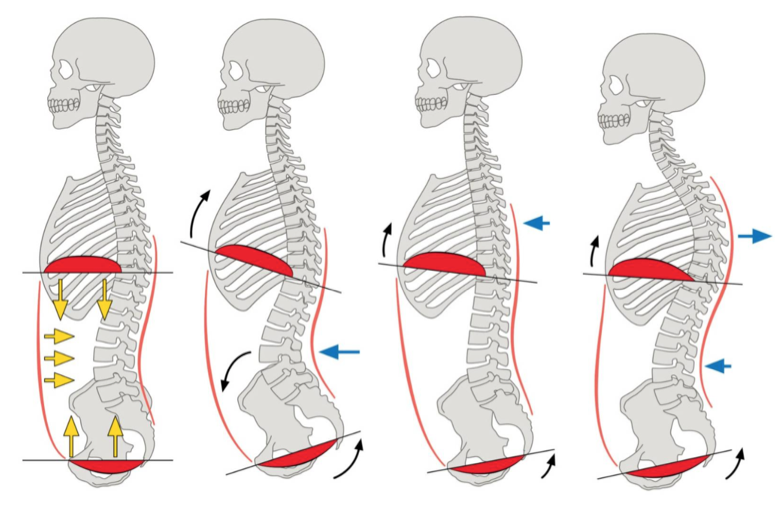
This is a closed container made up of your ribcage, abdomen, and pelvis that generates, manages, and distributes pressure every time you breathe, move, or play. Below is an example:
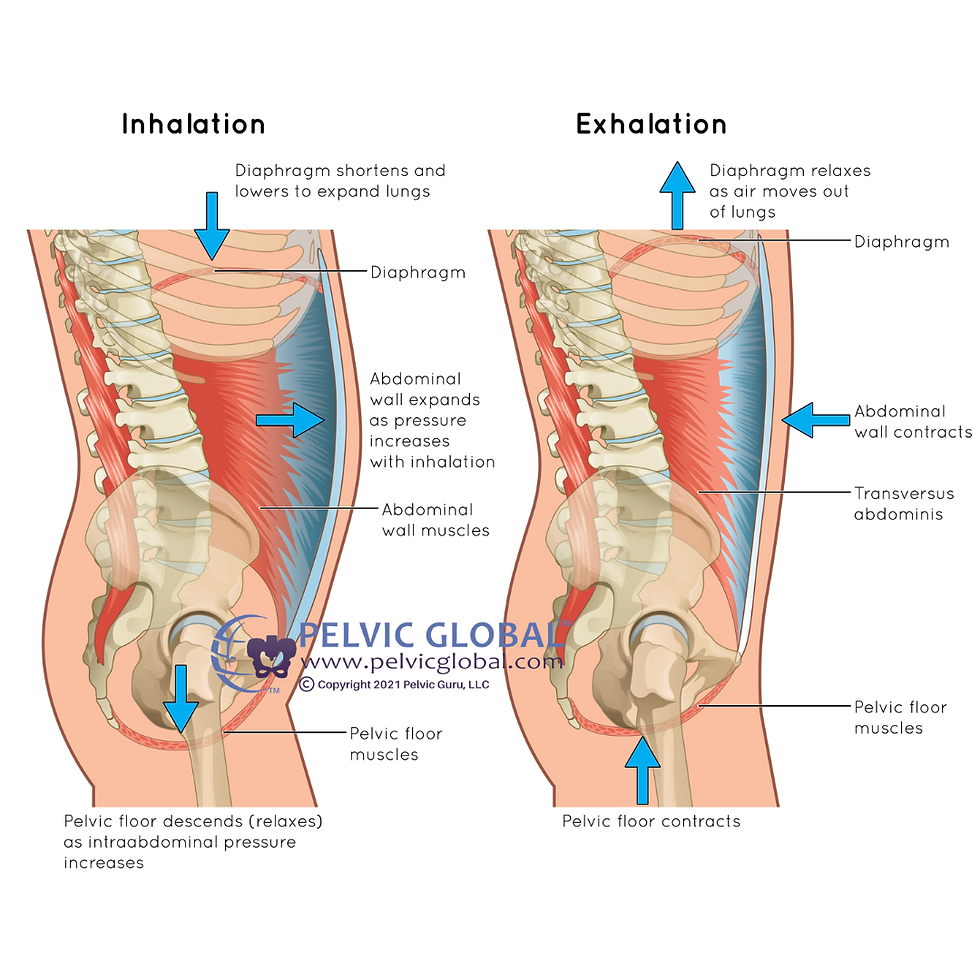
At the center of this system is your ribcage. It's designed to expand cylindrically during inhalation. During inhalation, the lower ribs flare outward, the sternum lifts, and the back ribs expand to receive air evenly throughout the chest wall. Here is a fantastic visual representation that demonstrates this movement.
On exhalation, the ribcage compresses inward to direct and support airflow out. This full, dynamic movement is what allows your body to build, control, and release pressure efficiently.
The Infrasternal Angle (ISA)
The key structural driver not discuessed within musical circles, is the importance of ribcage structure and it's influence on breathing movement and overall movement stratiges. We can get a look into one's ribcage structure by looking at the infrasternal angle, or ISA.
infrasternal angle (ISA) is the angle between your lower ribs at the base of your sternum. A narrower ISA will have an infrasternal angle of around 90 degress or less, while a wide ISA will have a ribcage greather than 100 degrees or so.
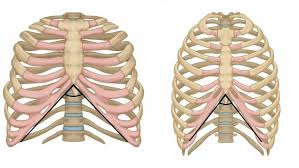
This is important, as when we start looking at breathing as a movement, narrows will tend to move more like an elevator door, with the side ribs having more expansion. These individuals will have an easier time with exhalation while they play, but a harder time with inhalation as they accumilate and hold onto tension.
Wide ISA's will move more like a garage door, with little side rib movement and moving their ribcage forward and up. Wide ISAs have a tendency to have a harder time with exhalation. If you think about the lower ribcage being more open relative to a narrow, this starts to make sense.
Regardless of structure, when the body starts to accumilate tension in various places, the ISA can stuck in a compensatory shape and lose the ability to move dynamically. As a result, the system starts to shift pressure elsewhere, usually to accessory breathing musculature like the neck, the jaw, and even the glottis.
Ever feel like you close off your throat going into the high range? Or maybe you feel your jaw start to lock up after prolonged periods of playing?
Small tangent aside, below the ribcage, the pelvis functions like a trampoline (under ideal conditions), absorbing downward pressure on inhalation and rebounding upward to support exhalation from below.
That upward rebound is the physical foundation of support on a wind or brass instrument. When the center of gravity moves to front and outside of the feet, the pelvic floor will compensate and start to brace. If the trampoline is compromised, the body again, has to find a way to manage that pressure fromt different parts of the body. Enter the abs, neck, jaw, or glottis (to name a few).
At the base of all of it is your contact with the ground, aka your feet!
Your feet have the ability to absorb load through the inner heel and push through the forefoot, generating the upward ground reaction force that feeds the entire system. This is where your base of support lives! Without these contacts, the pressure system above it has nothing to work from.
This is the container your breathing happens inside of. And the resting state of this container, before you ever pick up your instrument, will influence how your body responds the moment you start playing.
The Problem With How Breathing Exercises Are Taught
Traditional breathing exercises are almost always taught within an active inhalation or active range. Some examples include filling up all the way for 4 counts and exhaling for 4 counts. I've seen some pedagogues suggest the use of a tube in the mouth, a variety of straws, or sucking air in a vercious mannr to overtrain inhalation.
These can be help tools depending on the goal! After all, these exercises can mimic what orchestral musicians need to be able to do under high stress conditions depending on the repertoire. Under this lens, breathing also becomes a skill that can be developed and refined, and that skill work is part of the solution.
But the problem is that these types of breathing exercises assume the student (or self) has a pressure system underneat that can tolerate these types of training exercises.
When the system is already operating under high resting tension, when the ribcage is stuck, the pelvic trampoline is flattened, and the body is bracing to manage pressure it can't contain, the body already has limited capacity to effeciently manage interal pressure. In this case, a few things could happen - the exercises could reinforce the compensatory breathing and movement behaviors, or the exercises could push the participant past fatigue. At this point, you could describe this zone as the danger zone, red zone, or zone where stuff just starts going downhill. The environment now changes. The resting structural conditions reassert themselves. The tension comes back. The Valsalva comes back.
This is the cycle players describe again and again: it works in my lesson and falls apart when I'm on my own.
For me, these types of breathing exercises were amazing for my playing. I had breaktrhough lessons, playing problems went away, and I left those lessons feeling on top of the world.
But fast forward a week, and my body started to feel tight and restricted.
Fast forward two weeks, and breathing and playing in this way felt like a chore, and my body would feel awful.
These were not mental blocks, but signs that a system couldn't handle these internal pressure demands. When I started training, I was't able to release any tension that accumulated, so within a week or two, my body's ability to manage pressure slowly dwindled, until the only way I could play comfotanbly was with a small, relaxed, and non-supported air stream.
Again, not good or bad. Not good pedagogy, not bad pedagogy. Just a system that could not properly manage it's internal pressure.
The Right Goal for Breathing Exercises
As I said before, breathing exercises are an integral part of the solution, if they are performed with the right intention.
Through my professional education, training various populations in chronic pain, and retraining hundreds of musicians breathing patterns, there are three goals breathing exercises should address and progress through a valsalva retraining process.
1. Reduce tension and decompress the system.
Before any skill work is possible, the resting tension in the pressure system needs to come down. This means using position, gravity, external pressure (like massage or SMR), and breath together to decompress the ribcage and reduce the chronic bracing.
Positional breathing drills such as hooklying, sidelying, prone, wall-supported positions use gravity to change the shape of the ribcage and reduce the demand on the accessory muscles that are overworking to compensate. This isn't technique practice. It's creating the conditions under which technique becomes possible.
Within these positions, working within tidal volume breathing conditions is ideal, as any active inhalation and exhalation already involves a degree of compensatory muscle activity.
A lot of people think reducing tension is something you do and can forget about it, but dependign on your life circumstances, envirnoment, internal pressures (mentally), phsyical health status, or daily health habits like sleep, hydration, or nutrition, reducing tension is going to be a skill every musician should develop, as tension is a naturall biproduct of the lifestyle and work that we do.
2. Restore and improve pressure management capacity.
Once the system is less defended, the work shifts to restoring the structural mechanics that were missing. This involves:restoring the ribcage's ability to expand and compress dynamically, restoring the pelvic floor's ability to rebound and support exhalation from below, and reestablishing the upward pressure chain from the ground up (foot contacts!).
Breathing exercises at this stage start to integrate specific breathing cues based on the infrasternal angle, while incorporating specific movements to help feel various bones, muscles, and systems working together. The ultimate goal with these progressions is to teach the body to manage pressure structurally, so that the body can both absorb and produce energy.
From here, the fun begins!
3. Train that capacity under stress so it holds.
Again, this is a goal we talked about earlier, but dependign on the breathing exercise, many will start here and wonder why they keep getting stuck. A pressure system that works in a quiet, controlled environment but collapses under performance conditions hasn't really been trained, it's been rehearsed in ideal conditions.
The final layer is progressive loading: gradually increasing the demand on the system through harder positions, movement, and applying instrument-specific application exercises, so that the structural capacity built in steps one and two holds up when it actually matters.
From there, a daily maitenance routine is incredibly helpful, or better yet, transitioning to a more formal training program combining recovery, cardio, and strength training is a great option to combine these concepts and add more longevivity to your career and life.
Why the Sequence Matters
These three goals must work in order.
Skipping to skill practice before tension is reduced means risking reinforcing the compensation. Reinforcing the compensation = increased tension = increased pressure = increased effort.
In addition, building capacity before tension is addressed means building on an unstable foundation. And loading before capacity is restored means the system has nothing to load - it will distribute the load ineffieciently.
To put it back into the context of this post, traditional breathing pedagogy tends to operate at the third goal, technique and load, without ever addressing the first two.
This is why the results feel inconsistent, context-dependent, and impossible to replicate under pressure.
This is why you may discover some techqnieus that work VERY well. You make progress for a few weeks and start feeling hopeful, only to fall backwards shortly after. You might have come accross a great exercise for you, you were just missing a huge piece of the puzzle: goal 1.
The good news is that nothing about this is permanent.
The pressure system is trainable
The ribcage mechanics can be restored.
The pelvic trampoline can come back online.
The resting tension can come down.
But this requires approaching breathing exercises with a different goal, not just pursuing better technique, but giving regular inputs to a system to help it become less tense, more capable, and built to hold under stress.
Breathing exercises haven't failed you. They've just been aimed at the wrong target.
If you're ready to approach them the right way, reducing tension first, building capacity second, training it under stress third, the waitlist for The Valsalva Method is the place to start. This program launches in June. Join the waitlist to be notified when enrollment opens as well as a special, email-only discount.